Best O-Gauge Track Plans for 4x6 Layouts: 5 Designs for Small Spaces in 2026
September 9, 2026
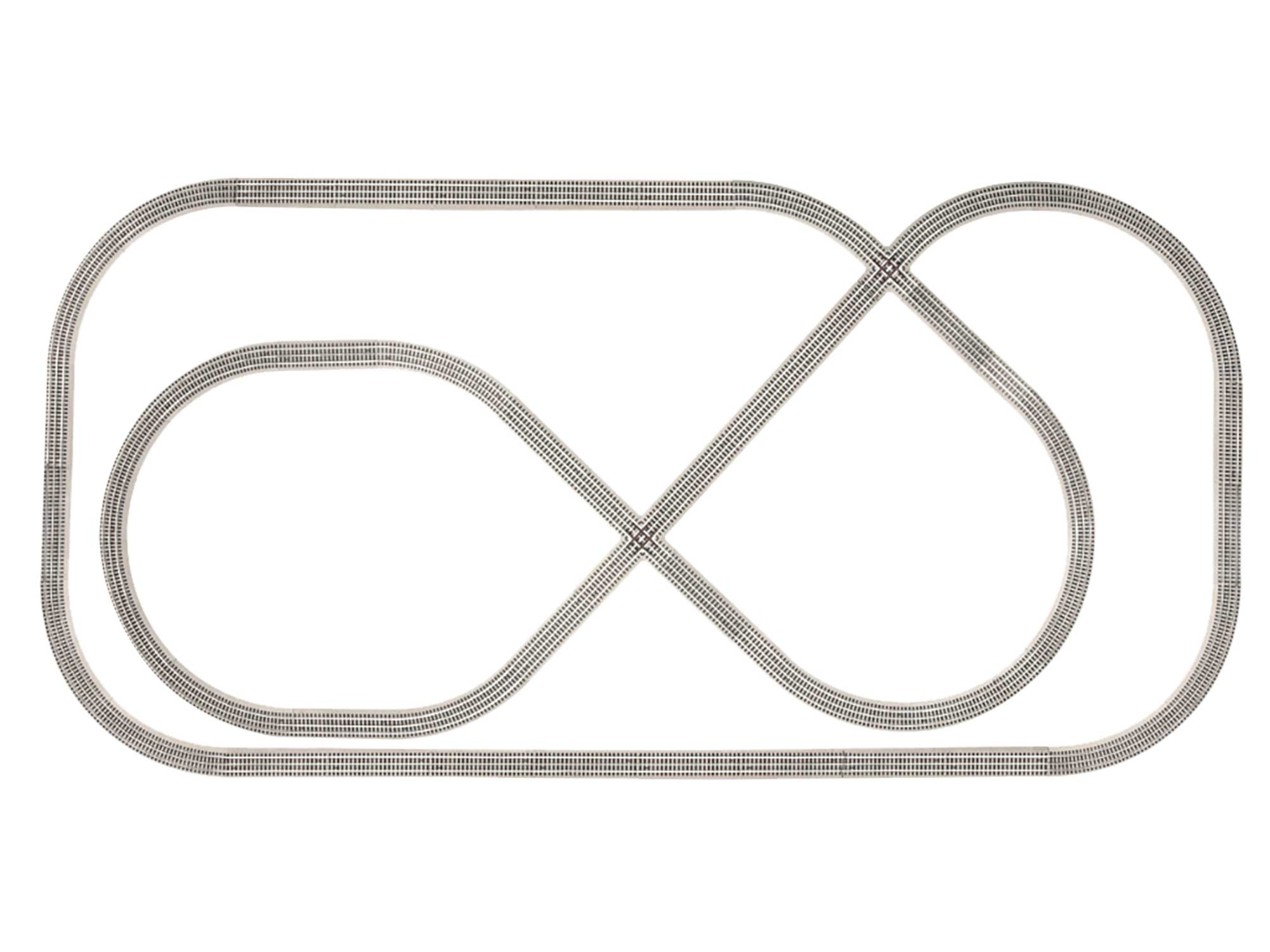
What are the best O-gauge track plans for a 4x6 layout? A 4x6 foot layout is one of the most common O-gauge starting sizes — small enough to fit in a spare bedroom, an apartment closet, or under a Christmas tree, but big enough to support real operations with sidings and industry spurs. 4x6 sits between the classic 4x8 sheet-of-plywood layout and the compact 4x4 minimum footprint.
This complete 2026 guide walks through the 5 best O-gauge 4x6 track plans, what fits on a 4x6 that doesn't fit on a 4x4, curve radius considerations, and how to build any of these plans in a single weekend under $400 in materials.
Why 4x6 Instead of 4x4 or 4x8
The 4x6 dimension offers a specific value proposition:
vs 4x4: 4x6 adds 8 square feet of layout area (a 50% increase). That extra 2 feet in one dimension enables O-36 curves (better locomotive selection than O-31), one or two industry sidings, and meaningful scenery around the tracks.
vs 4x8: 4x6 uses 25% less space than 4x8. In a small bedroom, apartment, or basement corner, that difference determines whether a layout fits at all.
vs 5x8: 4x6 gives up half the operational potential of 5x8. For hobbyists who eventually want O-42 curves and full switching operations, 5x8 is a better choice. See our 5x8 track plans guide.
Sweet spot use case: First layout for hobbyists with limited space. Christmas layout that stays up year-round. Kid's layout in a bedroom. Basement corner layout adjacent to other uses.
What Fits on a 4x6
A 4x6 layout supports:
- One O-36 outer loop with several inches of scenery around edges
- One or two industry sidings
- One passing siding along a long side
- Single train operation with switching moves
- Small station or industry scene
- Modest scenery (elevation change, foreground/background separation)
- One locomotive at a time (or two with careful block wiring)
The 5 Best 4x6 Track Plans
Plan 1: Classic O-36 Oval with Passing Siding
The straightforward starter design. Single O-36 outer loop with one passing siding along a long side.
Track needed: 12 O-36 curves, 6 straights, 1 passing siding kit (2 turnouts + connecting straights).
Trains supported: One locomotive with continuous running. Two locomotives with careful block wiring at the passing siding.
Operations: Continuous running with train meets at the passing siding.
Difficulty: Beginner. Assembly in one afternoon.
Best for: First layouts, casual operation, kids' layouts.
Plan 2: Figure-8 with Center Crossing
A figure-8 design where the train crosses itself at the center diamond. Visually engaging even with a single locomotive.
Track needed: 8 O-36 curves, 8 straights, 1 90-degree crossover kit.
Trains supported: One locomotive with continuous running.
Operations: Continuous running with visual crossing action. Good for spectators.
Difficulty: Intermediate. Requires precise track alignment at the crossing.
Best for: Visual displays, Christmas trees (train visible on both sides).
Plan 3: Oval Plus Two Industry Sidings
Operations-focused design. Single O-36 loop with two industry sidings enabling real switching operations.
Track needed: 12 O-36 curves, 10 straights, 3-4 turnouts (O-31 or O-36).
Trains supported: One locomotive with switching operations.
Operations: Prototype-based switching with industry deliveries. Car forwarding operations with 3-6 car consists.
Difficulty: Intermediate. Requires thoughtful industry placement.
Best for: Operations-focused hobbyists on small layouts.
Plan 4: Two-Loop Concentric Design
Inner O-31 loop with outer O-36 loop. Enables two-train simultaneous operation.
Track needed: 8 O-36 curves, 8 O-31 curves, 10 straights, 1-2 transition curves.
Trains supported: Two locomotives operating simultaneously on separate loops.
Operations: Continuous running with independent train control.
Difficulty: Intermediate. Two loops means twice the track work.
Best for: Multi-operator families where two people want to run trains simultaneously.
Plan 5: Around-the-Christmas-Tree Design
Optimized for under-the-tree operation. Simple oval that surrounds a tree base with clear sightlines.
Track needed: 12 O-36 curves, 4 straights (adjust to fit tree base). Total: about 22 pieces.
Trains supported: One locomotive (typically LionChief Polar Express).
Operations: Simple continuous running for holiday display.
Difficulty: Beginner. Straightforward setup.
Best for: Christmas layouts, seasonal decoration.
Curve Radius on 4x6
A 4x6 layout supports:
O-31 curves: Works with smaller locomotives (0-4-0 switchers, small diesels, Thomas). Reserved for tight-space designs or inner loops in concentric setups.
O-36 curves: The standard 4x6 curve size. Works with most LionChief locomotives (Polar Express Berkshire, GP38 diesels, small steam).
O-42 curves: Marginal on 4x6. Fits with careful planning but leaves almost no scenery margin. Better suited to 5x8+.
Larger curves: Don't fit on 4x6.
See our O-gauge curve radius guide for locomotive compatibility.
Materials and Cost
Building a 4x6 layout requires:
Table: 4x6 plywood cut from a 4x8 sheet, plus framing lumber. $60-$120 for materials.
Track (typical single-loop plan): Lionel Deluxe FasTrack Layout Set (682346, 54-piece) at $299-$349 covers most 4x6 designs. Individual pieces alternative: $175-$225 for a starter oval + passing siding.
Transformer: Lionel CW-80 (80W) at $75-$95 for single-locomotive operation. Upgrade to PowerMaster 180 for multi-locomotive operation.
Sub-roadbed and ballast: $30-$60 for basic scenery materials.
Total: $300-$550 for a functional 4x6 layout excluding locomotives and rolling stock.
Weekend Build Sequence
Saturday morning (2-3 hours): Cut plywood to 4x6. Frame with 2x4 lumber. Attach legs. Level.
Saturday afternoon (2-3 hours): Test-fit track without fastening. Adjust for any issues. Wire transformer and test operation.
Sunday (2-4 hours): Screw down FasTrack. Add basic scenery — ballast, ground cover, one or two buildings.
Total: One weekend to functional operation, ongoing scenery development over months.
Common 4x6 Mistakes
Overpacking track. The 4x6 is small — 4-6 track pieces of scenery margin around the outer loop looks better than track running to the edge.
Using O-31 when O-36 fits. O-36 gives you better locomotive selection at the cost of only 2-3 inches of layout margin. Use O-36 unless you specifically need O-31 for a tight configuration.
Undersized transformer. CW-80 handles one locomotive comfortably. Adding accessories (lit buildings, animated pieces) benefits from PowerMaster 180 or higher.
Ignoring aisle access. If the 4x6 sits against a wall, reach across is 3+ feet. Consider a fold-out access panel for the far side.
Growing Beyond 4x6
A 4x6 works as a stepping stone. Common expansions:
Add a 2x4 extension: Total footprint becomes 4x8 or 6x6. Adds a yard, industry area, or scenic feature.
Rebuild as 5x8: Move to 5x8 for O-42 curves and full switching operations.
Add a shelf layout extension: A 12-inch shelf along a wall extends operational range without doubling floor space.
Frequently Asked Questions
Can I run a Berkshire on a 4x6 layout?
Marginal. Berkshires require O-42 minimum curves for reliable operation, and O-42 is tight on 4x6. Small Berkshires might work but appearance is compromised. Better to run smaller locomotives (0-8-0, 2-8-0, LionChief F-units, small diesels).
What's the smallest useful O-gauge layout?
4x6 is generally considered the smallest for a full-featured layout with meaningful scenery. Smaller (4x4 or 3x5) works for simple Christmas ovals but doesn't support real operations.
How many locomotives can I run on a 4x6?
One at a time comfortably. Two with careful block wiring and a passing siding. Not enough space for full independent multi-train operation — that requires 5x8 or larger.
What's the best track brand for a 4x6?
Lionel FasTrack for easy assembly and integration with Lionel Deluxe Layout Sets. Atlas O for scale-realism and lower per-foot cost. Both work; FasTrack is simpler for beginners.
How long does building a 4x6 take?
Table and basic track: one weekend (8-12 hours). Full scenery: months of gradual work. Functional after the first weekend.
Verdict
A 4x6 O-gauge layout is the sweet spot for space-constrained hobbyists — big enough for real operations, small enough to fit almost anywhere. Any of the 5 track plans above delivers meaningful operating capability with under $500 in materials. Start with a simple oval plus passing siding, then expand to switching-focused operations as your interest grows. For related layout guidance, see our 5x8 track plans, our 4x8 track plans, and our curve radius guide.
Newsletter
Weekly O-gauge tips & reviews
New reviews, layout ideas, and hobby news — straight to your inbox.