Design Your Railroad

Track Layout Plans

Thirteen field-tested O-gauge track plans for every room size and skill level — from a compact phone booth to a full railroad empire. Every plan includes a real track diagram and practical builder tips.

BeginnerIntermediateAdvancedOperationsExpert
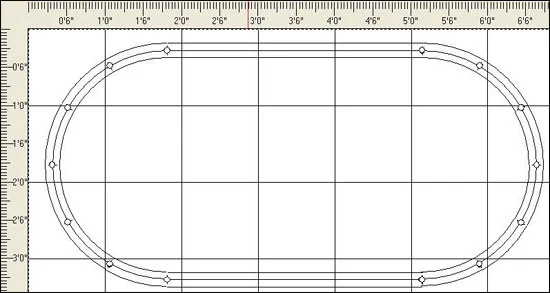
The Loop track plan diagram
Beginner#01

The Loop

Best for: Beginners • Space: 4×8 ft • Complexity: Easy

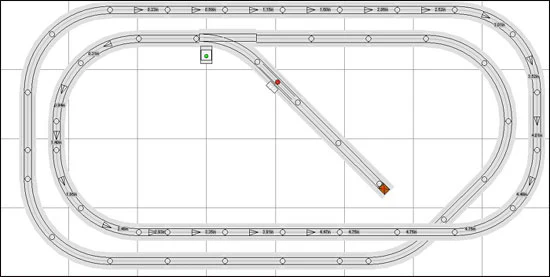
Every O-gauge layout starts somewhere, and it usually starts here. A continuous loop on a 4×8 sheet of plywood delivers nonstop running, clear sight lines from every angle, and enough room for a passing siding that turns solo running into real two-locomotive operation. Choose O-36 FasTrack curves for standard locomotives or step up to O-48 if you plan to add Vision Line steam down the road. The loop earns its reputation because it simply works — and veteran builders keep coming back to it whenever they want a layout that just runs.

Builder Tips

  • Use O-48 curves from day one if you plan to run Vision Line or full-length passenger cars
  • A single passing siding immediately enables two-locomotive operations without sacrificing continuous run
  • Position every section within arm's reach so you never have to climb over benchwork
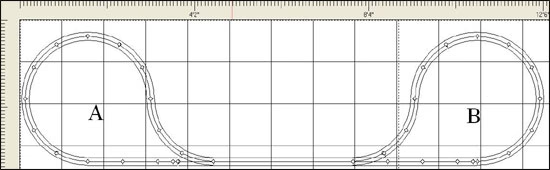
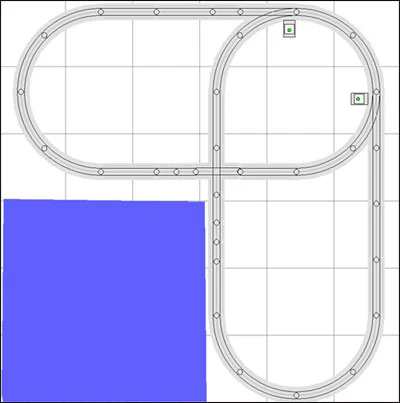
Loop-to-Loop track plan diagram
Intermediate#02

Loop-to-Loop

Best for: Intermediate • Space: 6×10 ft • Complexity: Moderate

Two loops connected by a working main line — the loop-to-loop translates how actual railroads operate into your basement. One end becomes a busy urban terminal with yard tracks and a platform; the other becomes an industrial district or rural classification yard. The connecting main is where your locomotives stretch their legs — long straights, optional grades, and room for the scenic set pieces that make visitors stop and look. This is the design that stops feeling like a train set and starts feeling like a railroad.

Builder Tips

  • Maximize the connecting run — the main line is where the performance and scenery pay off
  • Designate one terminal as urban and the other as rural for natural visual contrast
  • A trestle or tunnel on the main adds dramatic impact with minimal construction effort
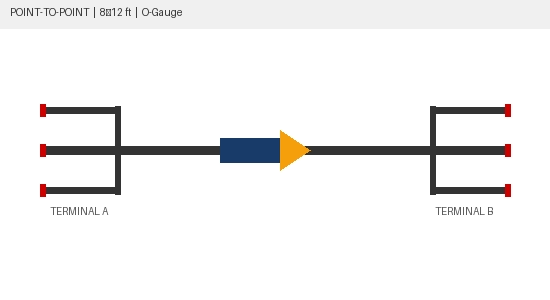
Point-to-Point track plan diagram
Operations#03

Point-to-Point

Best for: Operations-Focused • Space: 8×12 ft • Complexity: Advanced

Point-to-point eliminates the loop entirely and builds a railroad the way actual railroads function: trains depart a terminal, work a main line with intermediate stops, and arrive somewhere. Switching moves at each end, car spotting at industries, and realistic scheduling create an operating experience no oval can replicate. The design challenge is building enough operational density at each terminal — yards, engine facilities, industry spurs — to make the work genuinely interesting. Layouts built to this standard don't just look like the real thing; they operate like it.

Builder Tips

  • Every terminal needs at least one industry spur — car spotting is where the operations live
  • A runaround track at each end lets you reposition the locomotive without a turntable
  • Car card and waybill systems generate realistic working orders for every session
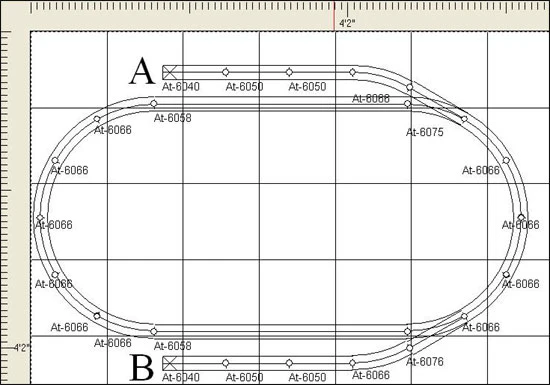
Out and Back track plan diagram
Intermediate#04

Out and Back

Best for: Intermediate • Space: 5×9 ft • Complexity: Moderate

The out-and-back is the point-to-point with a twist: the train departs one terminal, runs the main line, reaches the far end, and returns to origin under its own power — no wye or turning required. A reversing loop at each end handles direction automatically, giving you the operational character of a prototype railroad run with the simplicity of set-it-and-watch operation. This is an ideal design for operators who want realistic train movement without constant hands-on attention.

Builder Tips

  • Loop-reverser modules handle the polarity geometry at each end automatically
  • A hidden staging yard behind the reversing loop creates the illusion of trains emerging from off-scene
  • Grade the main line gently — the return run has to climb the same hill in the opposite direction
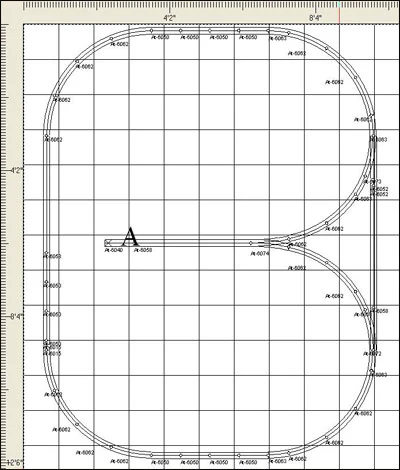
Point-to-Loop track plan diagram
Intermediate#05

Point-to-Loop

Best for: Intermediate • Space: 6×10 ft • Complexity: Moderate

A hybrid design that gives you the operational depth of a terminal stub at one end and the continuous running satisfaction of a loop at the other. Park a locomotive in the terminal, dispatch it down the main, watch it complete laps of the loop, then return and spot it back. The loop end is perfect for a scenic centerpiece — a mountain, a bridge scene, a downtown — while the terminal end handles the operational work. Two different experiences in one layout footprint.

Builder Tips

  • Build the terminal end first — it's the operational heart of the layout
  • The loop is your scenic showcase — invest the scenery budget there
  • A removable cassette at the terminal lets you stage different consists between sessions
Double Loop track plan diagram
Intermediate#06

Double Loop

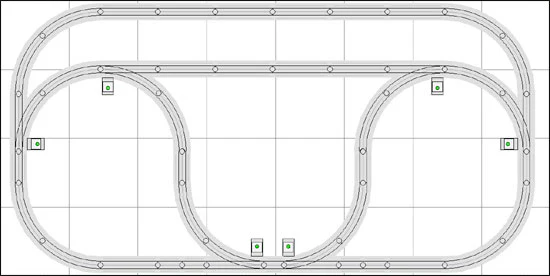
Best for: Intermediate • Space: 5×10 ft • Complexity: Moderate

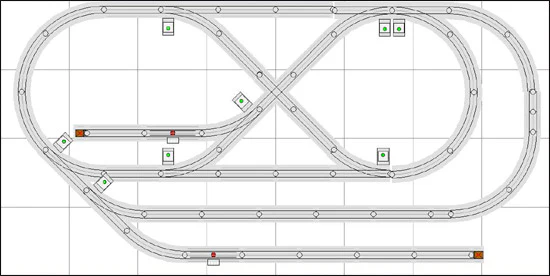
Two independent loops connected by crossover tracks — the double loop supports simultaneous two-train operation on a footprint not much larger than a single oval. One train runs the outer loop, one runs the inner, and crossovers let you shift a consist from one main to the other. This is the natural step up from a basic oval: same continuous-run satisfaction, twice the complexity, and the visual payoff of watching two trains navigate independent circuits without collision.

Builder Tips

  • Install cab control or DCS block detection to prevent nose-to-nose meets on the crossover sections
  • Use the inner loop for shorter consists and the outer for your longest passenger trains
  • Crossover placement determines where your operating interest concentrates — center them in your best scenic area
Double Back track plan diagram
Intermediate#07

Double Back

Best for: Intermediate • Space: 5×11 ft • Complexity: Moderate

The double back — sometimes called a dog bone — connects two end loops with a double-track main line. The locomotive runs continuous laps while appearing to travel a genuine bi-directional main. In a long narrow room the effect is striking: your train disappears around one curve, charges the length at speed, then vanishes around the other end. The double-track main supports two-train meets impossible on a single-track oval. If you have a basement corridor or spare bedroom that runs long and narrow, the double back is the answer.

Builder Tips

  • Use wide curves at the end loops — tight curves make the ends look like toy track
  • Running opposite-direction trains simultaneously on the double main is the most impressive O-gauge operation there is
  • A bridge or tunnel centered on one straight anchors the scenic treatment perfectly
Twice Around track plan diagram
Advanced#08

Twice Around

Best for: Experienced • Space: 8×12 ft • Complexity: Advanced

The twice-around uses a helix or gentle grade to stack two loops on the same footprint — the train climbs to a second level, runs an elevated loop, then descends back to the lower level. The result is dramatically more track footage in the same floor space, with the visual interest of an upper level that commands the room. Scenery options open up significantly: a mountain with the helix hidden inside, a valley scene on the lower level, industrial district on the upper. This is how serious builders double their railroad without doubling their floor space.

Builder Tips

  • Keep grades at 2% maximum — O-gauge locomotives with full consists will stall on steeper climbs
  • Build the helix as removable sections so you can reach derailments inside the spiral
  • Upper and lower levels benefit from independent power districts with separate transformers
Phone Booth track plan diagram
Beginner#09

Phone Booth

Best for: Small Spaces • Space: 2×4 ft • Complexity: Easy

The phone booth layout packs a complete O-gauge operating experience into the smallest possible footprint — sometimes as compact as 2×4 feet. Tight O-27 curves, a stub-end terminal, and a couple of industry spurs create genuine switching interest without requiring a dedicated room. This is the apartment layout, the office layout, the layout that actually gets built and runs rather than staying a future project. Small doesn't mean simple: the operational density per square foot of a well-designed compact layout often exceeds anything a larger plan can offer.

Builder Tips

  • O-27 track makes compact layouts viable in spaces where standard O-gauge won't physically fit
  • Every spur should serve a specific industry — the story of the layout lives in those details
  • LED lighting under the layout board dramatically improves the visual presence of a small layout
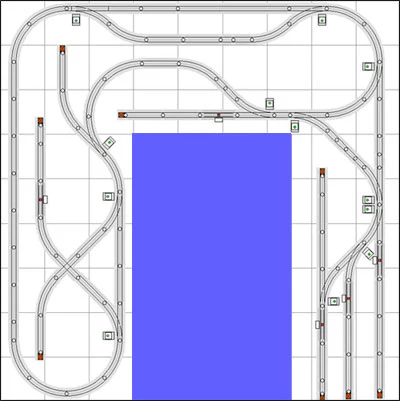
Southern Railroad track plan diagram
Advanced#10

Southern Railroad

Best for: Experienced • Space: 10×14 ft • Complexity: Advanced

A prototype-inspired design modeled on Southern Railroad operations — long freight runs, mountain terrain, and the operational rhythms of a real Appalachian main line. Multiple passing sidings, a classification yard, and industry spurs along the route create a layout you can run with actual working orders rather than simply watching trains loop. The Southern's territory is visually rich: tunnels through mountain grades, trestles over river gorges, and depots from a specific American era. Building to a prototype gives your scenery decisions a blueprint and your operations a logic.

Builder Tips

  • Southern Railroad steam — Mikado, Pacific, and Mountain classes — is well-represented in O-gauge
  • Period-appropriate structures from the 1940s–50s define the Southern's distinctive visual character
  • Timetable and train order operations suit Southern-style layouts perfectly for serious operators
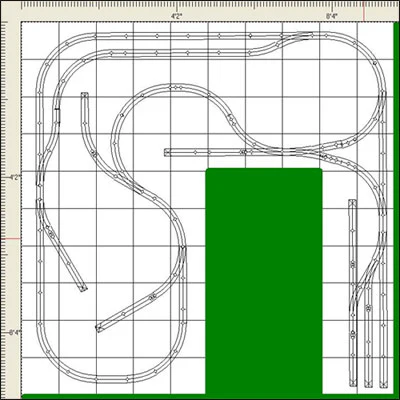
SRC Railroad track plan diagram
Advanced#11

SRC Railroad

Best for: Experienced • Space: 10×14 ft • Complexity: Advanced

A semi-freelanced regional railroad design combining the operational depth of a prototype-inspired layout with the creative freedom of your own railroad. The SRC layout features a well-developed yard complex, multiple mainline routes, and industry spurs that generate meaningful switching work each session. Freelanced railroads let you mix equipment from multiple prototypes — Lionel, MTH, and Williams locomotives from different eras can coexist on a freelanced pike in a way that would be historically incorrect on a strict prototype layout.

Builder Tips

  • Establish a geographic setting and era early — it guides every structure and equipment purchase
  • Freelanced reporting marks and paint schemes give your layout a unique identity that becomes yours
  • An operations manual for your own railroad — crew assignments, train symbols, industry procedures — elevates every session
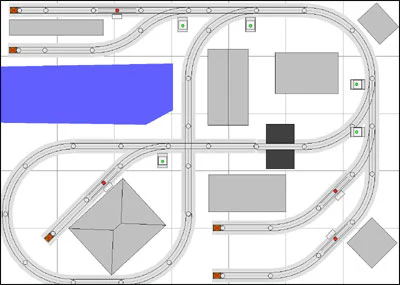
SRC Atlas Plan track plan diagram
Intermediate#12

SRC Atlas Plan

Best for: Intermediate • Space: 8×12 ft • Complexity: Moderate

An Atlas-style track planning approach applied to O-gauge — systematic, space-efficient, and built around proven geometric principles. The SRC Atlas plan uses standardized curve radii and turnout geometry to create a layout that flows naturally, with smooth transitions between sections and sight lines that work from every viewing angle. Atlas track planning methodology emphasizes building a complete, operating layout before adding scenery — the opposite of the common mistake of perfecting one corner before running the first train.

Builder Tips

  • Complete all track, wiring, and testing before laying a single piece of scenery
  • Atlas planning software (or SCARM for O-gauge) lets you validate clearances before cutting benchwork
  • Build scenery in modular sections so each part can be lifted off for track access and maintenance
Savannah Railroad track plan diagram
Advanced#13

Savannah Railroad

Best for: Experienced • Space: 10×16 ft • Complexity: Advanced

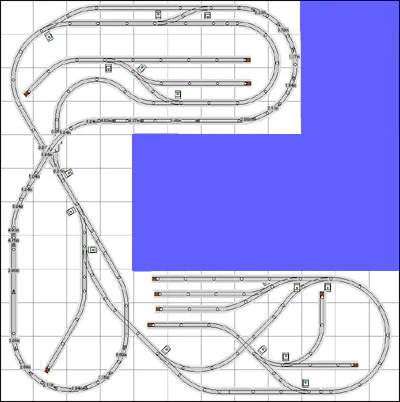
A coastal Southern railroad design capturing the flat terrain, tidal marshes, and industrial character of the Georgia and South Carolina lowcountry. Port facilities, a paper mill or cotton compress, and long low trestles over marshland define the scenic vocabulary. Operationally, the Savannah region means long freight consists, interchange with multiple connecting roads, and the particular logic of a port railroad where cars move to and from ships. The flat topography is deceptively easy to build — the scenic interest comes from water, vegetation, and industrial complexity rather than mountains.

Builder Tips

  • Lowcountry scenery — marsh grass, Spanish moss, weathered timber trestles — is visually distinctive and achievable
  • Port interchange operations with staging tracks simulating the 'off-scene' connecting railroad adds serious depth
  • Lionel's Southern locomotives and Seaboard freight cars fit this setting perfectly

Ready to Build?

The right locomotive makes every layout better. Check our rankings for the best O-gauge locomotives at every price point.