Best O-Gauge Track Plans for 5x8 Layouts: 5 Designs That Beat the 4x8
August 18, 2026
A 5x8 O-gauge layout is one of the most popular sizes for hobbyists building in a spare bedroom, den, garage corner, or basement alcove. Slightly larger than the classic 4x8 sheet of plywood, a 5x8 gives you meaningful extra width — enough to comfortably fit an O-42 outer loop instead of being locked to O-31, add sidings and industry spurs that a 4x8 can't quite accommodate, and run larger locomotives (Berkshires, Hudsons, F-units) with proper visual character.
This complete 2026 guide walks through the best O-gauge 5x8 track plan designs: what a 5x8 gives you that a 4x8 doesn't, five specific track plan designs from simple oval to switching-focused layout, curve radius considerations, and how to build any of these plans in a weekend.
Why 5x8 Over 4x8
The extra foot of width matters more than it sounds:
O-42 curves fit comfortably. A 4x8 barely accommodates an O-31 loop. A 5x8 gives you room for a full O-42 outer loop with several inches of scenery around the edges. O-42 opens up a much wider range of locomotives — medium steam (Berkshires, Hudsons) and modern F-units run reliably and look proportional on O-42.
Sidings become practical. On a 4x8 you can barely fit one short siding. On a 5x8 you can add two industry spurs, a passing siding, and interchange track — real switching operations become possible.
Better scenery. A 5x8 gives you 4-6 inches of scenery around the outer edges of your track. That's the difference between a track-on-plywood look and something that reads as a real layout.
Extra square footage: 4x8 = 32 square feet. 5x8 = 40 square feet. That's 25% more layout area for the same relative space commitment.
What Fits on a 5x8
A 5x8 O-gauge layout can accommodate:
- One or two loops of continuous running
- 2-4 industry sidings with realistic operations
- A small yard (2-3 tracks) for consist storage
- A passing siding for train meets
- Small station scene with platform
- Modest scenery (elevation change, foreground/background separation)
- Two independent-control locomotives operating simultaneously
The 5 Best 5x8 Track Plans
Plan 1: Classic O-42 Oval Plus Passing Siding
The straightforward starter design. Single O-42 outer loop with a passing siding along one long side.
Track needed: 12 O-42 curves, 6 O-42 straights, 1 passing siding kit (2 turnouts + connecting straights).
Trains supported: One or two locomotives (with block wiring), up to 8-10 car consists.
Operations: Continuous running with train meets at the passing siding.
Difficulty: Beginner. Assembly in an afternoon.
Best for: First layouts, casual operation, kids' layouts with expansion room.
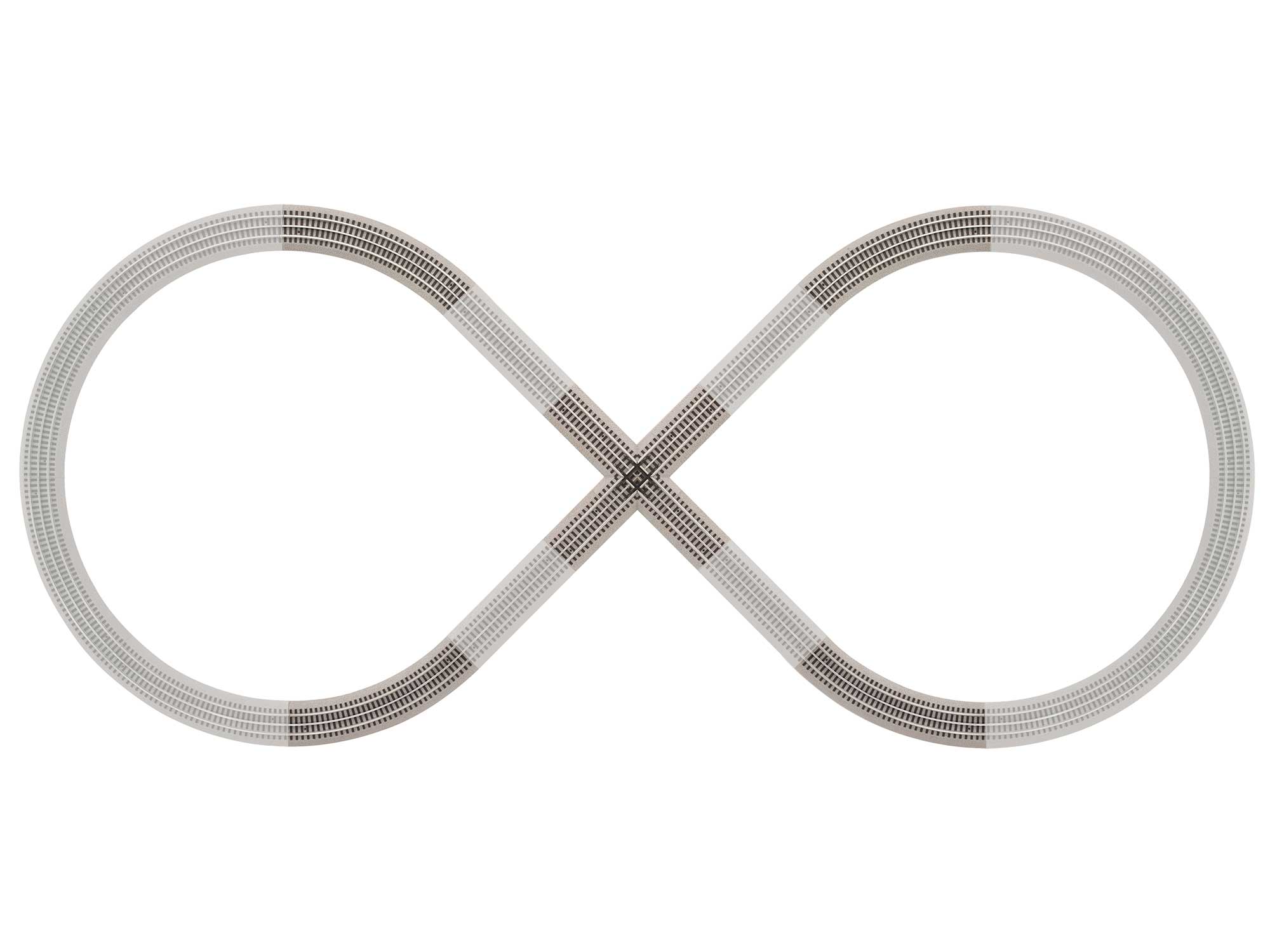
Plan 2: Figure-8 with Center Passing
A figure-8 with a passing siding in the middle. Trains cross themselves at the center diamond, adding visual interest to continuous running.
Track needed: 10 O-42 curves, 8 O-42 straights, 1 crossover kit (X-crossing), 1 passing siding.
Trains supported: Two locomotives operating simultaneously with careful signal timing at the diamond.
Operations: Continuous running with train crossing action at the center diamond. Very visually engaging.
Difficulty: Intermediate. Requires precise track alignment at the diamond.
Best for: Hobbyists who want visual continuous-running interest beyond a simple oval.
Plan 3: Double-Loop with Common Yard
Two concentric loops (O-42 outer, O-36 inner) sharing a small yard along one short side. Enables two independent trains running simultaneously.
Track needed: 12 O-42 curves, 12 O-36 curves, 12 straights, 3-4 turnouts for yard tracks.
Trains supported: Two locomotives operating simultaneously on separate loops. Yard supports consist storage and interchange.
Operations: Continuous running with independent train control. Yard operations for switching between loops.
Difficulty: Intermediate. Two loops means twice the track work.
Best for: Multi-operator families where two people want to run trains simultaneously.
Plan 4: Switching Layout with Continuous Loop
The operations-focused design. Small continuous loop for train movement plus multiple industry sidings, interchange track, and switching lead. Real operating potential with car forwarding, industry deliveries, and interchange.
Track needed: 8 O-42 curves, 8-10 straights, 5-6 turnouts (O-36 or O-42), interchange track.
Trains supported: One or two locomotives with switching-focused operation. Consists remain small (3-6 cars) for realistic operations.
Operations: Prototype-based switching operations. Car forwarding, industry deliveries, interchange sorting. Highly engaging for solo operators.
Difficulty: Advanced. Requires thoughtful industry placement and switching plan.
Best for: Serious operators who prefer switching to continuous running. Excellent for solo operating sessions.
Plan 5: Around-the-Room Style on 5x8
Rather than a rectangular island layout, position the 5x8 against a wall and design an around-the-room feel with backdrop and depth. Track runs along the visible sides with scenic depth against the wall side.
Track needed: 12 O-42 curves, 6-8 straights, 2-3 turnouts for sidings.
Trains supported: One or two locomotives with continuous running.
Operations: Continuous running with scenic depth. Feels bigger than 5x8 due to backdrop and viewing angle.
Difficulty: Intermediate. Requires backdrop construction and scenic planning.
Best for: Hobbyists who want scenic depth beyond flat-plywood construction. Excellent for photography.
Curve Radius Considerations
The 5x8 dimension specifically enables O-42 as your standard outer radius. This matters for locomotive selection:
O-31 minimum: All Lionel LionChief locomotives, most small steam (0-4-0, 0-6-0, small 4-6-0), diesel switchers (SW, RS, GP7), most freight cars.
O-42 minimum: Medium steam (Berkshire, Hudson, K4), F-unit diesels, most modern six-axle diesels (SD40, GP60), most passenger cars.
O-54 minimum: Larger steam (Northern, Mountain), some articulated steam, extended-length passenger cars, large modern diesels (SD70 series).
O-72 minimum: Large articulated steam (Challenger, Big Boy, Allegheny), full-length modern passenger cars, large modern diesels.
A 5x8 supports O-42 comfortably, which means medium-large equipment runs reliably. Wider curves (O-54) fit if you sacrifice some scenery depth. Wider still (O-72) generally requires a larger footprint (6x10+) to work well.
For complete curve radius guidance, see our O-gauge curve radius guide.
Materials and Cost
Basic materials for a 5x8 layout:
Table: 5x8 plywood sheet (custom cut from 4x8 sheet plus additional foot). $75-$150 for plywood, $50-$100 for framing lumber and legs. Total table build $150-$300.
Track (typical single-loop plan): Lionel FasTrack O-42 oval with passing siding runs $175-$225 in new track. Used FasTrack $75-$125.
Transformer: Lionel 80-watt CW-80 transformer $75-$95 (adequate for one locomotive). Lionel 180-watt Powermaster $200-$275 (better for two locomotives with room for accessories).
Sub-roadbed and ballast: Cork or foam sub-roadbed $30-$50. Ballast and scenic materials $50-$100 for basic scenery.
Total table + track + basic transformer: $400-$600 for a functional 5x8 layout excluding locomotives and rolling stock.
Weekend Build Sequence
Realistic timeline for building a 5x8 layout:
Friday evening (2-3 hours): Cut plywood to 5x8 dimensions. Frame the table with 2x4 lumber. Attach legs. Level.
Saturday morning (3-4 hours): Lay out track plan on paper. Test-fit track on plywood without fastening. Adjust for any issues.
Saturday afternoon (2-3 hours): Screw down FasTrack to plywood (through the pre-drilled holes in each piece). Wire transformer to track. Test operation with a locomotive.
Sunday (as much time as you want): Add scenery — ballast, ground cover, buildings, trees, backdrops. This is the never-ending stage that continues over months and years.
Common 5x8 Mistakes to Avoid
Cramming in too much track. Beginners often try to pack maximum track onto their 5x8. Result: everything crowded, no room for scenery, unrealistic proportions. Better: fewer track pieces, more scenery.
Using O-31 when O-42 fits. The 5x8 specifically supports O-42. Using O-31 wastes the extra width and locks you out of medium-large locomotives.
Ignoring aisle access. If the 5x8 sits against a wall, plan how you'll reach the far side for maintenance and derailment recovery. Consider making the far side accessible via a fold-down section or by keeping the table 24-30 inches from the wall.
Fixed transformer location. Wire your transformer with enough cable slack that it can move around during operating sessions. Fixed-position controllers become annoying over time.
Skipping block wiring. Even a small 5x8 benefits from block wiring for two-train operation. See our block wiring guide.
Growing Beyond 5x8
A 5x8 is an excellent stepping stone. Common next steps:
Add a 2x4 extension: A small extension off one side of the 5x8 adds a yard, industry area, or scenic feature. Total footprint 5x10 or 7x8.
Rebuild as L-shape: Add a full 5x8 or 4x8 as an L extension. Total footprint 8x10-8x13 with dramatically expanded operating potential.
Add a helix to a second level: A helix in one corner enables a second layout level. Effective footprint doubles. See our helix building guide.
Frequently Asked Questions
Can I run a Big Boy on a 5x8 layout?
No. Big Boy requires O-72 minimum curves, which don't fit on a 5x8. For Big Boy operation, you need a minimum footprint around 6x10 with O-72 curves, ideally larger.
How many locomotives can I run on a 5x8?
Two locomotives can operate simultaneously with proper block wiring. Two-loop plans support fully independent two-train operation. Single-loop plans support two trains with careful spacing and passing siding usage.
What's the smallest table that fits a full O-gauge layout with scenery?
5x8 is generally considered the minimum for a full-featured O-gauge layout with meaningful scenery. Smaller (4x6, 4x8) works but scenery gets compressed. Larger (6x10+) enables significantly more elaborate designs.
How long does building a 5x8 take?
Table and basic track: one weekend (8-12 hours total across Friday-Sunday). Full scenery and detail: several months of gradual work. The layout is functional after the first weekend; scenery development is the long-term hobby.
What's the best track brand for a 5x8?
Lionel FasTrack for easy assembly and beginner-friendly click-together construction. Atlas O for scale-realism and lower cost per foot. Both work well; the decision depends on whether you prioritize convenience (FasTrack) or realism (Atlas). See our track systems comparison.
Verdict
A 5x8 O-gauge layout is the sweet spot for many hobbyists — big enough to support O-42 curves and meaningful operations, small enough to fit in a spare bedroom or basement corner. The five track plans above cover a range from beginner-friendly single-loop to serious switching-focused operations. Any of them can be built in a weekend with under $500 in materials excluding locomotives and rolling stock. For related layout planning guidance, see our 4x8 small space track plans, our curve radius guide, and our block wiring guide to plan your build end-to-end.
Newsletter
Weekly O-gauge tips & reviews
New reviews, layout ideas, and hobby news — straight to your inbox.